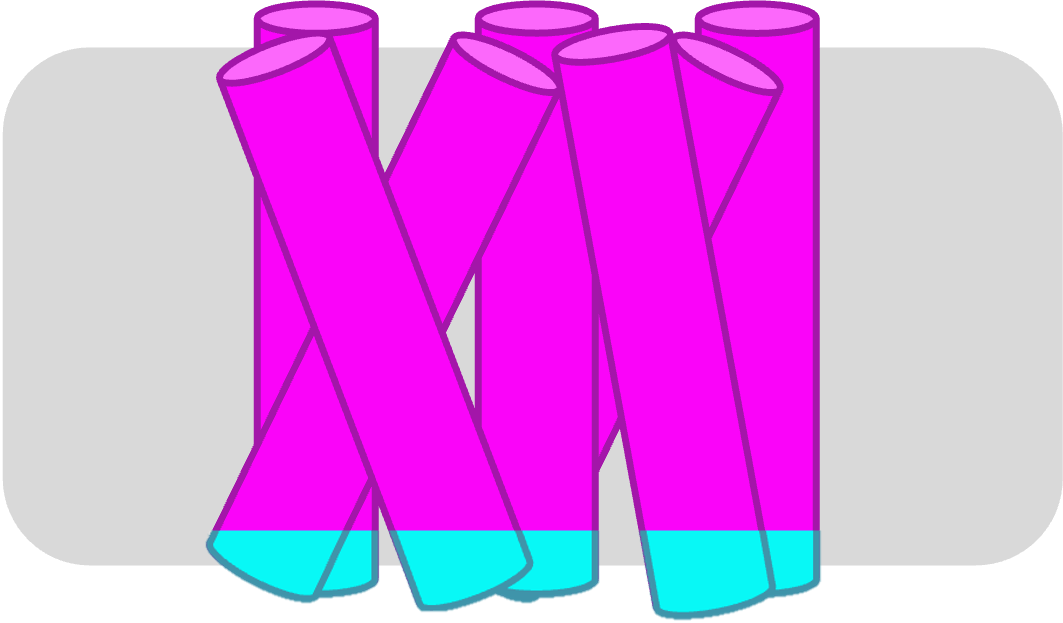
Designing a Novel Chimera with GPCRchimeraDB
This section describes how to use GPCRchimeraDB to guide the design of a novel chimera involving GPCRx, the GPCR under investigation. The design process starts with selecting the appropriate design type (Type 1, 2, or 3, see manuscript), which determines whether GPCRx will serve as the EC or IC parent of the chimera:
Type 1 or 2: Used for studying the functionality or signaling pathway of GPCRx. In this case, GPCRx will be the IC parent.
Type 3: Used for uncovering the 3D structure or conducting ligand screening of GPCRx. Here, GPCRx will be the EC parent.
The next step is selecting GPCRy, the second parent. GPCRy should be a well-characterized receptor that complements gaps in knowledge about GPCRx. Depending on the design type:
For Type 1 or 2, GPCRy should have a known ligand.
For Type 3, GPCRy should have a known stabilizing effector.
Finally, the cutting sites in both GPCRx and GPCRy must be carefully determined to ensure that the resulting chimera can activate and successfully transmit the signal from the outside to the inside of the cell.
GPCRchimeraDB facilitates each stage of this design process, as outlined in the following steps:
Step 1: Explore the Entry Page of GPCRx
Each entry page in GPCRchimeraDB integrates annotations from major databases, providing an overview for further analysis. This includes:
Mutation impact: Reviewing known mutations and their effects.
Evolutionary score: Comparing GPCRx to its subclass.
Motif conservation: Identifying regions that are sensitive to mutations.
PTM sites and interacting residues: Understanding their role in GPCRx function.
Since chimeric design introduces stretches of mutations, understanding these factors is critical. The 1D-3D viewer allows direct examination of key residues in their 3D context.
Step 2: Define Potential GPCRy Candidates
Selecting an appropriate GPCRy depends on the design type:
For Type 1 and Type 3 chimeras, GPCRy is usually Rhodopsin and the κ-Opioid receptor, respectively.
For Type 2 chimeras, multiple candidates may be suitable. To identify GPCRy, consider:
Well-characterized receptors: Avoid orphan GPCRs (use the ligand-based subclass filter).
Phylogenetic similarity: Chimeras between related GPCRs tend to be more successful (filter by subclass).
G protein compatibility: Select a GPCRy that either binds the same or a different G protein as GPCRx.
Previous chimeric designs: Check past chimeras involving GPCRx or related receptors.
Experimental feasibility: Avoid receptors with regulatory or experimental constraints (e.g., opioid-related GPCRs).
Once suitable GPCRy candidates are identified, their entry pages should be explored (as in Step 1) to gain insights into their key residues.
Step 3: Determine Cutting Sites
Cutting sites for GPCRx and GPCRy must be carefully chosen to enhance chimera design success. Based on literature, the following guidelines are recommended:
Preserve microswitches: Ensure that essential microswitches for the EC parent remain intact.
Maintain secondary structure: Introduce cutting sites within regions that share the same secondary structure.
Favor the EC parent: The chimeric sequence should resemble the EC parent as closely as possible.
Preserve G protein binding: The IC parent should contribute residues responsible for G protein binding.