Sequence Alignment tool
Here we describe step-by-step how to compute the alignment of sequences of interest:
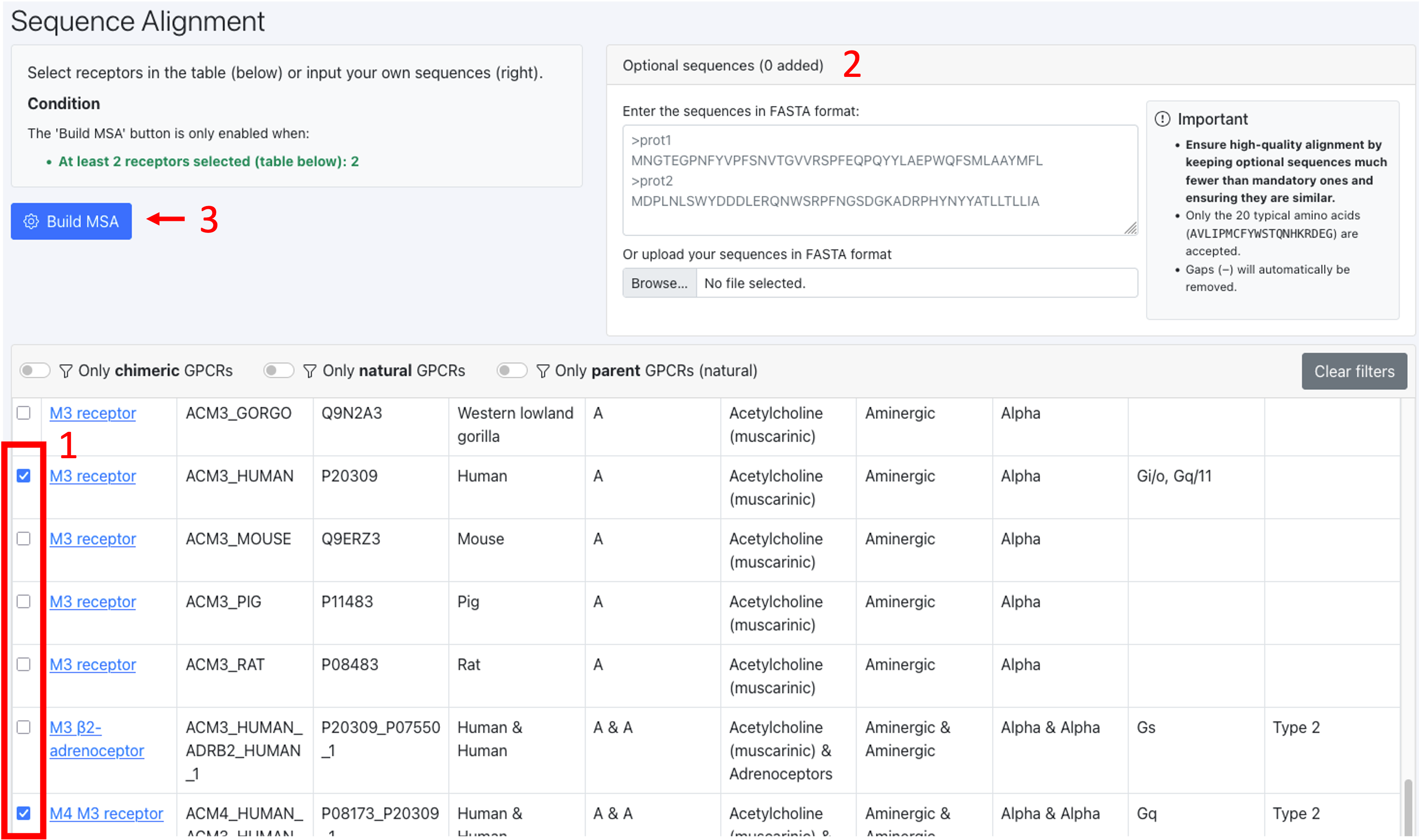
1. Select at least 2 sequences from the table using the tick boxes (mandatory sequences). In this table you find all sequences available on GPCRchimeraDB.
2. Optional: Input your own sequences in FASTA format or upload a FASTA files containing your own sequences using the card on the right.
How to ensure a high-quality alignment: Ensure high-quality alignment by keeping optional sequences much fewer than mandatory ones and ensuring they are similar. This is because the mandatory sequences defined the HMM profile that will be used to guide the alignment of the optional sequences.
Click the button “Build MSA”. MSA stands for Multiple Sequence Alignment.
4. On the Results page, you can either download the alignment in FASTA format or direclty analyze the alignment. You can scroll horizontally. Hover over a residue to view its aligned and unaligned position as well as its generic numbering.
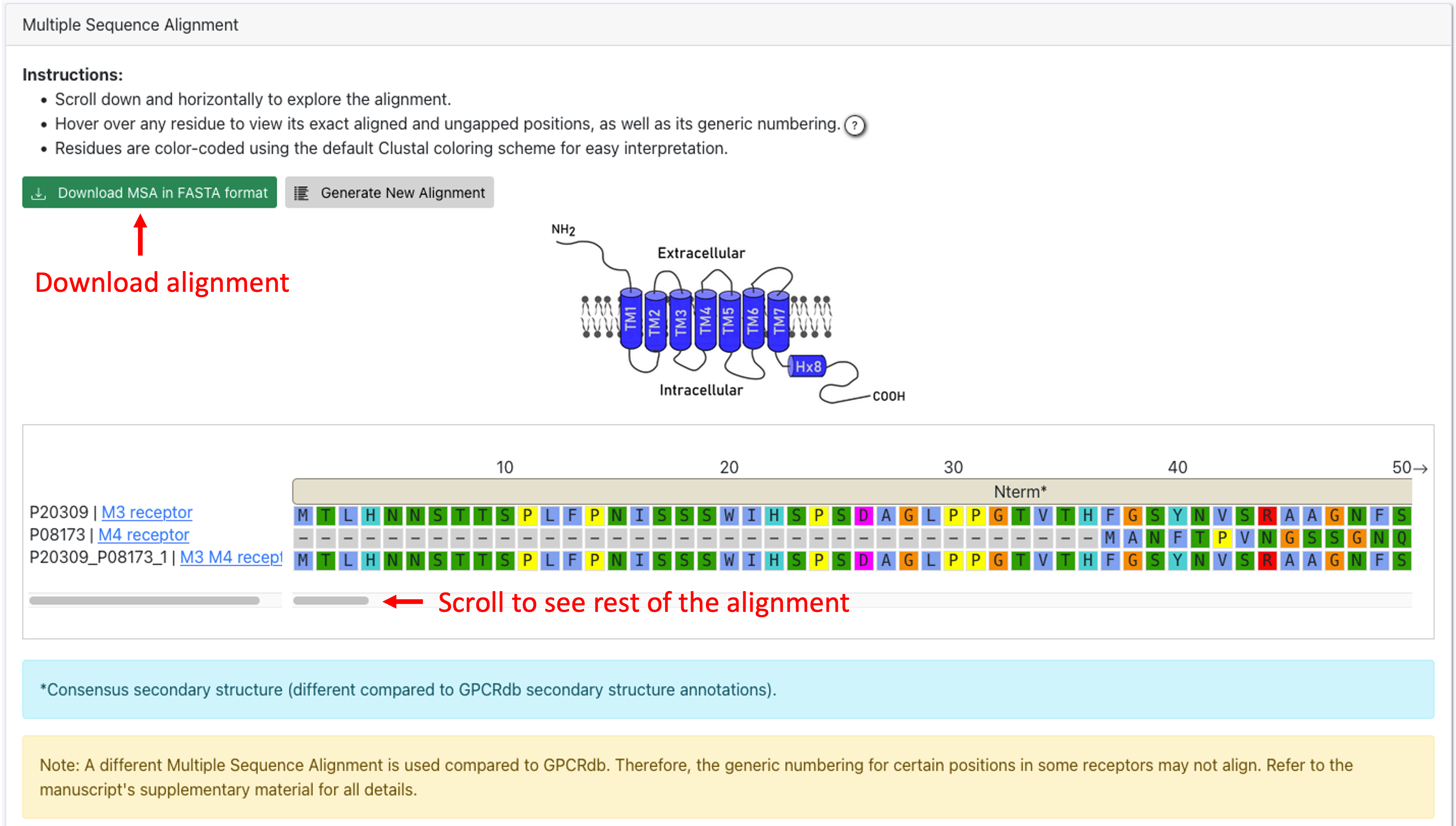
The secondary structure annotations of the alignment are obtained by computing the consensus secondary structure annotations of the aligned sequences
Why are there more sequences in my alignment than I originally selected? If you selected chimeric sequences in the Mandatory Sequences card, additional sequences may have been automatically included. This is because aligning a chimera is more accurate when both of its parent sequences are present in the master alignment. To ensure optimal alignment, the parents of a chimera are automatically added to the dataset whenever a chimera is selected for alignment.
Why is the GPCRchimeraDB alignment slightly different compared to GPCRdb? We generated a structure informed MSA of all human GPCRs (extended to all mammalian GPCRs) with SIMSApiper. It allows us to use predicted models of GPCRs without experimental structure to support their alignment. We compared this alignment with the GPCRdb alignment and while both alignments are in agreement for the vast majority of receptors, notable differences emerge for some orphan GPCRs. Accurate alignments are essential for identifying equivalent regions between receptors and are a critical step for chimera design, the broader research project supported by GPCRchimeraDB. Therefore, we use a slightly different alignment compared to GPCRdb.